


Overview
Food prices, more particularly food inflation, have been a topic of contention for the past five years. As a result, in late January 2026 the Canadian federal government launched a National Food Security Strategy, touted as a means of combatting rising food prices domestically. In a briefing, the Prime Minister’s office stated that the goal of the strategy is to strengthen domestic production while providing access to affordable food. Taken at face value, this statement should be supported by everyone; however, it seems the focus may be rooted more in short-term policies that supply affordable food than in long-term solutions that bolster domestic production, and that comes at a high cost. Beef is a prime example in the case of rising food prices, with record prices continuing to be topped in each of the past three years.
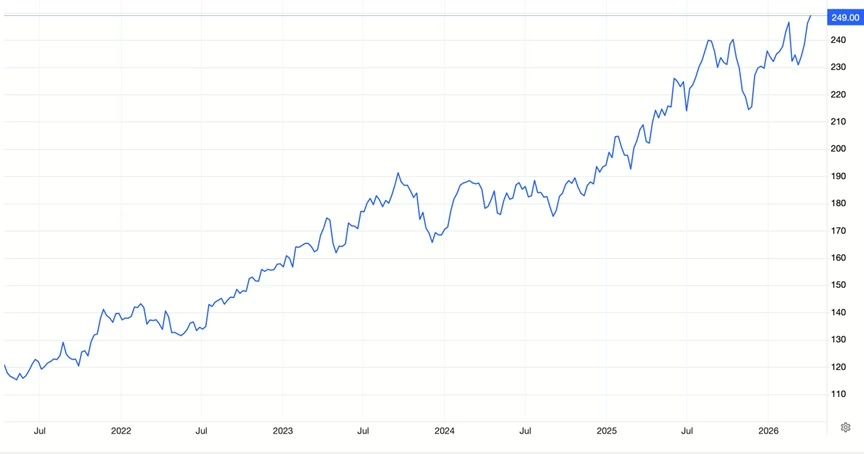
Drought, tight margins, and conversion of grassland to arable acres are all contributing factors to shrinking beef supplies here in Canada and in the United States. Given the highly integrated nature of our markets (comprising the largest two-way trade of live cattle in the world) prices on both sides of the 49th parallel have rallied substantially in the past five years. As a result, governments are scrambling to provide consumers with relief in the meat aisle and may be moving in the wrong direction, if food security is the overarching concern.
Figure 1. Five-year US live cattle market prices (USD)
Recently, the Government of Canada re-entered negotiations with the Mercosur trade pact, hoping to reach a deal by September of 2026. This would result in greater market access for Canada into markets including Brazil, Argentina, Paraguay, and Uraguay; however, it remains unclear what our government intends to export to these nations. Mercosur and Canada are global competitors in many categories including agriculture. While the world’s largest beef producing nation (Brazil) stands to gain immensely from access to Canadian consumers, there is much to risk for Canadian farmers and ranchers. Canadian beef producers oppose this move for many reasons, and I will make a case for their validity here.
Beef, But different
Aside from being called beef, Canadian and Brazilian beef have little in common, with much of Brazil’s production being of far lower quality than Canada’s world-renowned beef products. There are many reasons for this, with the primary factor being the climate in which the cattle are raised. The equatorial climate of Brazil limits 80% of their production to Bos indicus cattle (Zebu), which have adapted to hot and humid climates. In Canada, Bos taurus cattle are utilized as they are well adapted to our cold winters. Bos taurus is known to have greater intramuscular fat deposits and improved tenderness relative to its Bos indicus counterpart. Canadians are used to a more marbled higher quality grade of beef. The risk here is negatively impacting consumer perceptions of beef in Canada by stocking shelves with a lower quality product that could deter Canadians from buying beef again.
The second major difference is in how the cattle are reared. In Canada, beef producers operate on a fixed (and ever shrinking) agricultural land base as urban sprawl and land conversion erase Canadian grasslands. In Brazil, beef producers have near-infinite means of expansion through conversion of the Amazon Rainforest to agricultural land. Accounting for deforestation and other factors, Brazilian beef has an emissions intensity nearly three times greater than that of Canadian beef.
The third difference in production involves the reasons why Mercosur beef is much cheaper than that in Canada. In Canada, we uphold the highest of animal health, labour rights, and food safety standards around the globe; the same cannot be said for Mercosur nations. Low-cost labour, food safety short-cuts, and minimal animal and minimal health regulations allow Mercosur nations to undercut the cost of Canadian beef. For example, just in labour alone, Mercosur countries have 80% lower costs.
The Ripple Effect
Canada is touted as one of the worlds top-quality beef producing nations. Our cold climate, low population density, and vast expanses of grassland grant us ideal cattle production opportunities. As a result, we produce twice as much beef as we can consume here in Canada, making the beef sector extremely export focused. Seventy-five percent of our exports go to the United States as boxed beef and live cattle. This relationship is fundamental to the survival of the Canadian cattle sector. Entering a deal with Mercosur places this relationship at risk. Organizations representing US beef producers have expressed concern regarding Canada’s entrance into any Mercosur trade deal involving beef. Their concerns are valid given the integrated nature of our beef production systems. What is to stop Mercosur beef from using Canada as a “backdoor” and entering the US by importing beef into Canada and then rerouting it to the US? As Canadian trade negotiators enter the 2026 review of the CUSMA agreement, Mercosur beef could be another potential major issue in resolving this review with timeliness. Adding friction to our most important trade relationship will affect all of the Canadian economy – not just agriculture.
Disease Concerns
In addition to environmental and quality concerns is the issue of foreign meat bringing diseases such as Foot and Mouth Disease (FMD) into our country. Brazil itself is recognized as being free from FMD; however, it is bordered by nations that are FMD free with vaccination (Paraguay) and those that are not free from FMD (Venezuela). Despite FMD-free status, Brazil has caused alarm amongst trading partners in the past after taking weeks to report on case of Bovine Spongiform Encephalopathy (BSE), calling into question the legitimacy of the nation’s disease reporting systems.
Canada is currently FMD free, a status that allows beef producers to maintain the global trade relations the industry relies on. If FMD were to enter the country, the mass vaccination and/or euthanasian of hundreds of thousands of cattle, swine, and sheep would soon follow. This would mean billions of dollars in losses for Canada. Further, trade access to the US and other export destinations would be blocked or restricted for many years. Domestic production would decrease dramatically, which would further inflate domestic beef prices in grocery stores. This is the potential long-term cost of granting more beef access to Mercosur countries, it risks ruining the livelihood of our livestock farmers, decreasing our domestic production and raising beef prices – all in the name of a slight, short-term reduction in cost at the grocery store.
Conclusion
Right now, optimism and incentive to build Canadian beef production exists. Flooding the market with cheap, low-quality imports will dampen this optimism, increases disease risk, hurts our trade, and lessens our food security prospects in the longer term. Saying no to Mercosur beef achieves the following:
- It upholds and improves Canadian consumer standards while expanding the Canadian beef sector
- Protects the Canadian Prairie Grasslands and the Amazon Rainforest simultaneously
- Protects all Canadian livestock sectors from disease, while communicating to other nations that their standards must meet ours
The choice is clear, Canadian beef is not a bargaining chip, just as domestic food security should not be a bargain we as Canadians should be willing to accept.