

Are our Food Messages Aligned?

Are our Food Messages Aligned?

Reflections from Cultivating Resilience

One of the advantages of being in the agricultural space is getting the opportunity to listen to viewpoints one normally wouldn’t hear. Sitting in my office in Saskatoon, my conversations are dominated by prairie sustainability, which is why participating in the two-day summit, Cultivating Resilience is so rewarding – it broadens the sustainability discussion to one inclusive of cross-Canadian differences. Those personal differences matter when we’re discussing food and, without consideration, can be barriers to true resiliency.

Food is culture. Food is medicine. Food is connection.

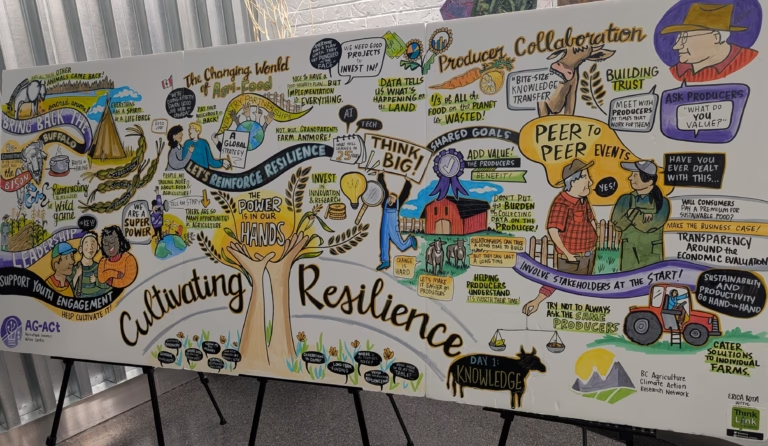
Day 1 - Knowledge

The first day began with a keynote from Kim McConnell, founder of agri-food marketing and communications agency, AdFarm, who reminded all of us that food security is more than availability; it is also affordability and accessibility. Those 3 As have informed the food values Canadian policy pursues however, with movement into the National Food Security Strategy, we’re now putting more attention on 4 Ss: software, security, sustainability, and supply chains. By incorporating these considerations into resiliency planning, McConnell believes not only that this will improve the quality of projects looking for funding but will also help bridge Canada’s gap between agriculture and food industries to a more cohesive agrifood sector.

Similar sentiments were echoed in the panel discussion regarding the value of producer collaboration. Moderator Jeremy Hogan (Nature Conservancy of Canada) noted that while sustainability and productivity feed into agrifood resiliency, they are separate goals and require very different approaches to realise them fully. That’s one of the critiques of agricultural research planning, says Ashley Honsberger, Interim Executive Director of Canadian Alliance for Net-Zero Agriculture (CANZA): meaningful collaboration should be driven by and tailored to producer needs rather than trying to mold farms to fit the objective. For Bruce Taylor (founder of Enviro-Stewards), holding this mentality would help the industry distinguish between simple on-farm solutions that require minor supports for farmers and large projects that are attractive from a funding perspective, but maybe won’t have the real-world impact they are designed to have. Kristine Flaim (Knowledge Transfer and Engagement lead at the Alberta AgriSystems Living Labs) confirms that provincial-scale changes can mask farm-level capabilities. Determining where those limitations exist is an advantage of building long term and well-maintained relationships with our agricultural community.

Are our Food Messages Aligned? 2
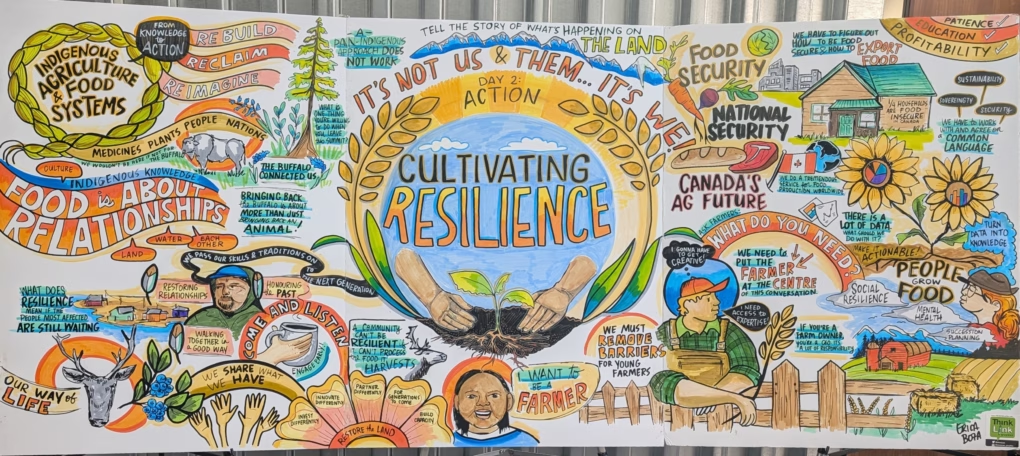
by Erica Bota (THINKLINK GRAPHICS)

Day 2 - Action

The second day’s keynote, Kallie Wood (Carry the Kettle Nakoda First Nation; National Circle for Indigenous Agriculture and Food), reminded us of the value of action. Reconciliation, for example, is designed to extend beyond land acknowledgements; what value does acknowledgement have without plans to change? Sovereignty, food security, resiliency… these are not new concepts in the agrifood space, but they are gaining more attention. With Canada’s eyes on the problem, says Wood, now is the time to act in a way that includes all stakeholders and the next generation of stakeholders. It is no longer enough to acknowledge our opportunities to improve, we must also improve the accessibility of those solutions.

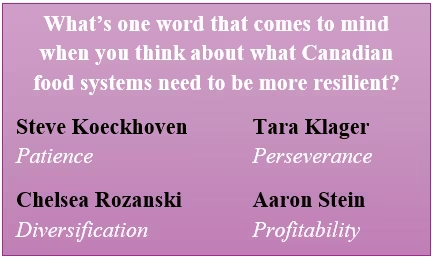
In the panel discussing Canada’s agricultural future, host David McInnes (DMci Strategies principal and expert discussant featured in last year’s Cultivating Resilience summit) recognized challenging sentiments of resiliency shared earlier throughout the summit. Steve Koeckhoven (director of investments at Verdex Capital) was the first individual I heard those two days to address a more realistic, less optimistic view of our food systems: no one outside of the agriculture community is actually thanking a farmer for their work. Because while there is overlap between the agrifood sustainability vocabulary we throw around in our discussions, Chelsea Rozanski (University of Calgary) believes doing so limits our ability to understand intrapersonal motivations, preventing our ability to move past research into actionable outcomes. Production food security, confirms Tara Klager (author and owner of Providence Lane Homestead), On a purple background: what's one word that comes to mind when you think about what Canadian food systems need to be more resilient? Answered by Steve Koeckhoven, Tara Klager, Chelsea Rozanski, and Aaron Steinis very different from consumer food security, and a failure to acknowledge that fact leads the industry to ask too much of farmers without providing the tools necessary for use. In these scenarios, research becomes noise, rather than, as Aaron Stein from the Alberta Federation of Agriculture notes, solutions that keep farmers in business. For farmers, that is sustainability, not the adoption of the newest technology. Technology alone is not resilience.
Are our Food Messages Aligned? 3
by Erica Bota (THINKLINK GRAPHICS)

Wâhkôhtowin

(Cree for being related to others)

Data and communication are opportunities for understanding. With open collaboration, we, as an industry, can improve the trust built between sectors and invest in meaningful adoption. Afterall, research without action or follow through is just information and, in Canada, we don’t have an information issue. We have a resiliency issue.

Leave a Reply

Your email address will not be published. Required fields are marked *

SAIFood uses Accessibility Checker to monitor our website's accessibility.