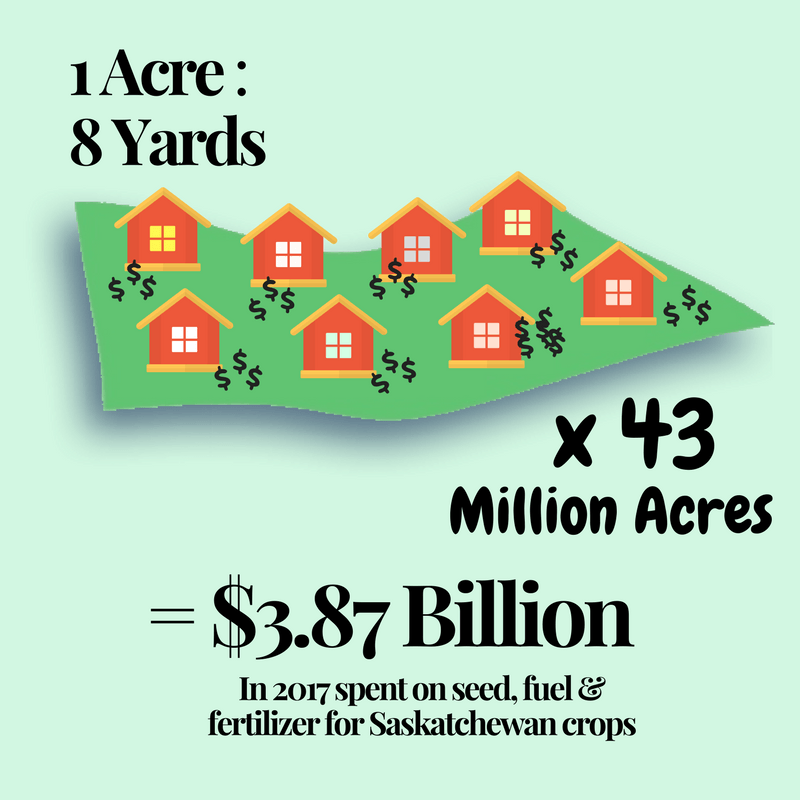
As spring begins to hint at its arrival, farmers across the country are busy getting ready to start seeding Canada’s millions of crop acres over the next two months. This spring, Saskatchewan farmers will seed over 40% of Canada’s farmland, ~43 million acres. Urban municipalities fit 8 residential lots or yards onto one acre of land[1], meaning farmers will seed 344 million city yards.
Many of us enjoy planting flowers or vegetables in our yards, for some working in the yard brightens our days and for others it puts the LT in the perfect BLT sandwich. When planting our yards we might spend anywhere from $20-50 or more depending on the size of your yard. It can add up when you include your potted flowers, new topsoil, fertilizer, water and pesticides. While it can add up to have a beautiful and fruitful yard, have you ever thought about how much farmers spend in the spring alone just on seed? Farmers in Saskatchewan will spend nearly $1.5 billion on the seed they need to plant their crops for 2018.
In 2017, Saskatchewan farmers spent $1.44 billion alone to purchase the seed they planted. This does not include the fertilizer purchased to help the crops grow, their purchased fuel needed to power the seeding implements and machinery. According to Statistics Canada, Saskatchewan farmers have spent an average of $1.75 billion on fertilizer and $675 million on fuel every year for the past 5 years. In total, that is nearly $4 billion spent on seed, fertilizer and fuel by farmers in Saskatchewan, all without a single guarantee that they will have anything to harvest.
While farming is profitable, there are risks as a crop can be lost to bad weather or pests. That’s why Saskatchewan farmers have the option of using crop insurance programs to provide them with a payout should their crop suffer due to weather conditions. Farmers can purchase insurance the same as you or I, however, their insurance may not cover all their losses like your fire insurance would. Crop insurance also only covers cases of not enough rain, too much rain, or hail; additional coverage comes at an additional cost.
When we plant flowers or vegetables in our yards, our small-scale give us the wonderful ability to control the amount of water (most cases), weeds and fertilizers. Whereas farmers are considerably constrained in these areas. Farmers know what they are doing, they have planned their year and know what to do in different scenarios, but the scale they farm gives them little real control over their farm. They can seed and fertilizer, but if they have insufficient rain and no irrigation, there is little they can do to help their crop grow. If our gardens or flowerbeds don’t get enough rain, we can water it ourselves.
It would be unlikely that a farmer would face the situation where their entire crop was a total failure. However, it is very common for small areas of farmland to suffer entire crop loss, most commonly due to drought. Crops are innovative and adaptive like farmers, they will survive without farmer intervention most times, but there’s a difference between surviving and being successful yielding crops that profits.
Investing billions with little to no guarantee of what kind of return one might receive, makes the risk-reward tradeoff rather unique. I wonder how many individuals outside of farming would be comfortable making this type of risk decision?
[1] Assuming the lots are 50’ x 100’.
Since 2019, the public health and food innovation spaces have focused on increasing protein consumption.… Read More
Over the past few months, there has been an extreme amount of social media propaganda… Read More
With the amount of information in the world, it can be easy to get lost… Read More
The DNA Series: This is the last blog in the DNA Series (boo!), and we're… Read More
The Heated Price of Coffee My morning starts with multiple cups of coffee. No, no… Read More
In January 2026, the Canadian government was able to reach an agreement with the Chinese… Read More
View Comments
Nice
Thank you!