

Regardless of dietary preferences, I think it would be difficult to find someone willing to confess they wish animals would suffer. We’ve discussed similar themes in the past on SAIFood but, to summarize, differences in opinions towards animal production and what constitutes as ethical can be formed by whether an individual is more interested in animal welfare or animal rights. Farmers have a fundamental obligation to proper animal treatment; evidence suggests beyond simple ethics that good animal welfare makes a difference at auction. When consumers confuse welfare with rights or when welfare changes are identified as insufficient improvements, it can negatively impact the overall reputation of Canadian farmers.
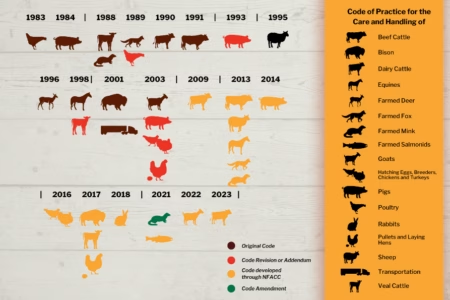
All animals used for production in Canada are subject to a bare minimum of care as laid out by the species-specific National Farm Animal Care Council’s (NFACC) Codes of Practice. Within these documents sit recommendations for space, feeding, handling, transport requirements, etc. that apply for any stakeholder interacting with the animal, as well as enforcement options undertaken by the Canadian Food Inspection Agency if noncompliance is discovered. By engaging the entire value chain in these Codes, realistic improvements and challenges to compliance can be better discussed and strategized against for the betterment of Canadian agriculture. By reviewing Codes every five years (many of which are expected to be updated in 2027), standards of care evolve with industry, trade partner requirements, and scientific conclusions.
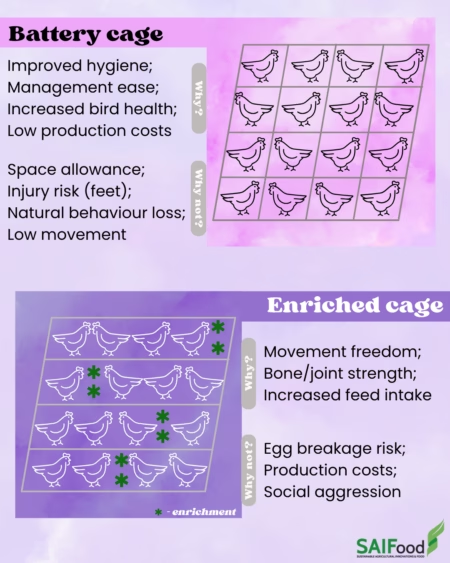
Individual companies and agrifood boards can also establish production standards, although those commitments tend to be less formal and more consumer-facing, often separate from production realities. Take the 2016 Retail Council of Canada’s (RCC) commitment to 100% cage-free egg use in processed foods: in 2021, the RCC scaled back that commitment, acknowledging that the pledge was inconsiderate of transition logistics, and instead aligning their requirements with NFACC welfare standards. The egg-producing chicken Code of Practice allows for enrichment cages, a battery cage with more space for natural behaviour expression and group housing. Now, it is worth acknowledging that analysing the impacts of enrichment cages are a priority in the 2027 poultry Code of Practice review, and that activist groups frequently make mistakes when describing enrichment cages (i.e. the minimum area of space required per bird is 750cm2 does not mean that is the total area of an enrichment cage). There are major bird welfare advantages to the use of enrichment cages however, the range in quality of enrichments that can be employed in these systems and general displeasure of caged production (opposed to welfare) are behind public scrutiny of enrichment cages.
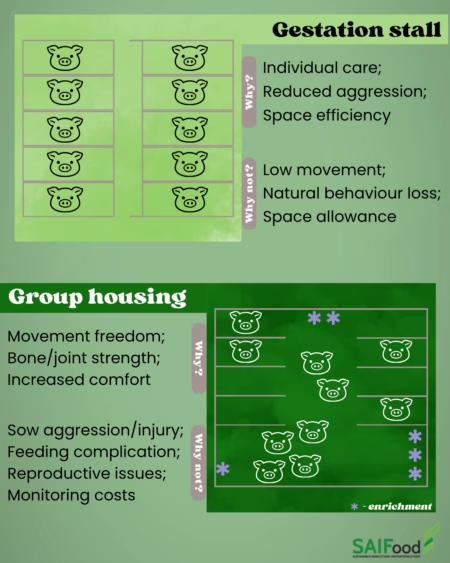
A similar case of the public informing policy before industry feasibility assessment comes from Canada’s commitment to group sow housing. Originally requiring all sow farmers in 2019 to convert to group housing (opposed to individual stations known as gestation crates) by 2024, government pushed the deadline back to July 2029 following industry comments that the timeline was too short for nation-wide conversion. While the welfare benefits to group housing are well-documented, only about a quarter of farmers have completed the 2–3-year conversion process. There will be no extension this time and yet, the industry is unable to meet policy in the years required. While this and the future strength of Canadian pork should be a cautionary tale about adequate industry consultation and transition support, the case of sow housing is yet another example of consumer and political enthusiasm outpacing feasibility and economic reality.
