


In developed countries, approximately half of children’s diets are met by ultra-processed foods, adding even more concern to a society simultaneously asking for freshness and proper adolescent health. It is the feeling that companies are ‘sneaking’ substances into our food that partially drives the active anti-processed food movement. More than half of the infamous “Dirty Dozen” list of additives is commonly used preservatives. Avoiding these substances, either by reading the label or abstaining from consumption altogether, depends on an individual’s concern and willingness to give up a product. See, while goods like potato chips are much easier to spot as unhealthy or full of additives, preservatives are also widespread in foods promoted as necessary parts of balanced meals like breakfast cereals, bread, and whole meats.
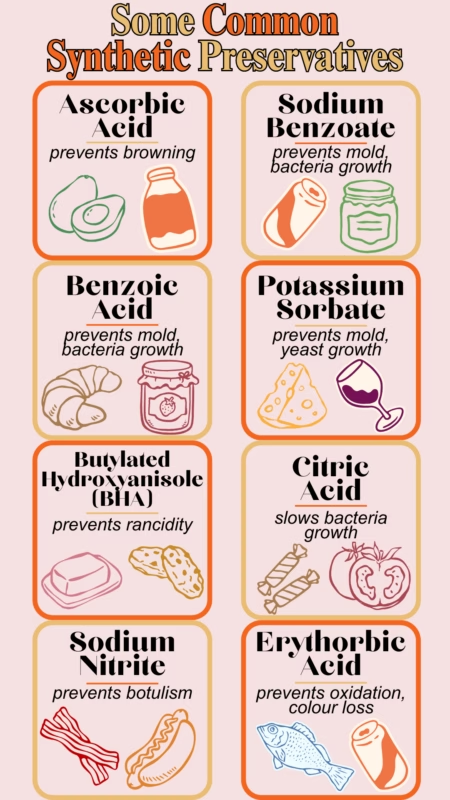
There are many gaps in the health assessment of preservatives. Preservatives are very rarely added during manufacturing on their own; it often takes a combination of additives to effectively control against spoilage. Our intestinal systems are complex environments, impacted not only by too many preservatives but also which preservatives and in what concentration they are introduced. Yet, research into the negative health consequences of consumption focus on short term high intakes of a single concentrated substance. This is not to say that scientific research is disingenuous (in fact, a few are incredibly robust assessments and used as examples of how health research should be conducted); it is stated to highlight that, much like with processed food in general, quantity matters more when it comes to health than what.
Not all preservatives are created equal, and there exists a multitude or preservatives to protect against a multitude of pathogens with a multitude of effectiveness depending on use. Fundamentally, it is not a fear of preservatives, overall, as we likely all reap the benefits of their function, but the synthetic preservatives – the ones with long chemical-sounding names and abbreviations that feel more like they are covering something up than helping convey information – that are the most worrisome. The risks from natural preservatives lessens as processing lessens, but if they are used as an additive, the health risks remain. In the same breath, salt (a natural preservative) can be perceived as good or bad depending on the quantity added and whether salt is acting as an ingredient or a preservative. Although consumers have a massive amount of power when it comes to motivating manufacturing innovation, traditional economic barriers such as the rate of commercialization and the elevated costs of natural compared to synthetic preservatives have created the processing status quo Canadians experience today.
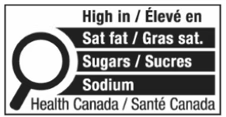
The interconnectedness of Canada and America’s food value chains means we have to discuss both countries in regard to preservative policy. Both nations, rather than targeting specific preservatives in the production process, have opted for demand-side policy. Beyond educating civilians about the health risks of overconsumption (i.e. food guides, whole food promotion), Canada has opted for front-of-package labels to highlight products high in natural preservatives and food stabilizers: saturated fat, sugar, and sodium. It boils down to consumers wanting higher transparency about what is added during processing but asked for by individuals without the scientific background to understand the information when it is provided. Adding information to the label, restricting allowable definitions, and reaffirming additive categorization and limits for manufacturers actually adds flexibility to Canada’s regulatory system, such that the food manufacturing innovation pipeline can partially manage and respond to itself. An informed consumer is able to confidently avoid certain foods, using buying power to inform how food is produced and where improvements would be accepted. This power provides some understanding into the generally-recognized-as-safe (GRAS) loophole in the United States.
It’s difficult to discuss processed foods in Canada without acknowledging the processing power and legislation of our southern neighbours from whom we import some of our favourite brands. Health Canada approves, studies, and sets maximum levels for all food additives in Canadian products whereas the United States will separate GRAS substances from additive categories. Substances that are GRAS do not require pre-market approval from the Food and Drug Administration (FDA), nor does the FDA need to be notified when those substances are added to products, because its safety has already been adequately reported. Doing so speeds up the rate at which food products enter the marketplace and, in theory, opens opportunities to innovate faster. However, what was originally designed to lower the legislative burden required for additives like vinegar, flour, and baking soda has allowed the entry of over 100 substances into the food system without FDA approval, some of which have been linked to the health concerns previously mentioned, reaffirming preservative fears. For this reason, American policymakers are being asked to better define ultra-processed foods and are considering making it mandatory for manufacturers to report and justify when GRAS substances are added.
