

In January 2026, the Canadian government was able to reach an agreement with the Chinese government regarding tariff rates on Chinese electric vehicles (EVs) imported into Canada and Canadian canola and pea imported into China. This announcement reduced existing tariff rates from 100% to considerably lower levels. However, the Chinese government made it clear their tariff concessions would only be applicable for the 2026 calendar year, pending further negotiations.
Tariffs and Retaliation
In August 2024, the Canadian government announced a tariff rate of 100% on Chinese EVs entering Canada. The tariff was set to come into effect on October 1st, 2024 and aligned Canada with a previous and identical tariff rate announced by the American government in May 2024, which came into effect in September 2024.
In doing this, Canada violated its commitment to the World Trade Organization (WTO), as the imposition of this tariff was not compliant with any of the WTO’s mechanisms for trade fairness. The Canadian government indicated it was enacting this tariff to protect the Canadian EV market and workers. However, Canada was not producing any EVs in August 2024 and still do not in 2026.
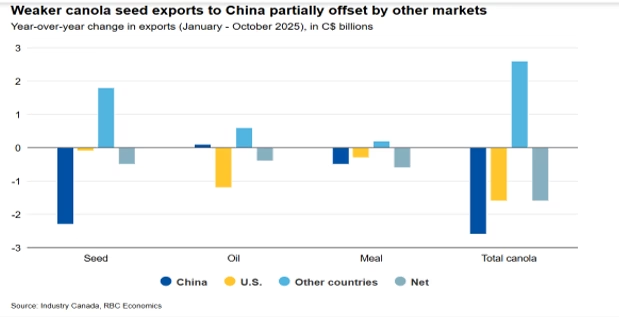
Seven months later, China retaliated. In March 2025, China announced tariffs of 100% on Canadian canola oil, canola meal, and pea imports, and a 25% tariff on Canadian pork and seafood products. These tariffs also violated China’s commitment to the WTO’s international trade rules and were in direct retaliation against the EV tariffs implemented by Canada in 2024. These tariffs had a significant impact on Canadian canola exports as identified by the RBC figure below.
Outcomes of Further Negotiations
As part of ensuring greater clarity for commodity markets and the larger agricultural industry, it was announced on February 28th, 2026, that a 5-year agreement had been reached between Canada and China regarding China’s import of canola seed only. This agreement lowers the tariff on Canadian canola imports to 14.9%.
At the end of June 2026, China announced new tariffs on the import of Canadian pea starch. Effective on July 1st, 2026, a tariff of 73.5% is being applied. In 2025, the value of pea starch exports to China were worth $14 million. While a relatively small portion of the overall agricultural exports from Canada to China, it represents the significant work ahead for the Canadian government to ensure that tariffs do not return to 100% on January 1st, 2027.
Negotiations between Canada and China on other commodity tariffs have not produced any beneficial results since the January 2026 announcement. China still applies a 25% tariff to pork imports. The January agreement removed the 25% tariff on Canadian seafood exports, but only until the end of the 2026 calendar year.
Negative Impact on Investments
In June 2026, the Canadian government announced a new Food Security Strategy for Canada, including $100 million for expanded food processing. These potential investments will only materialize with international export market access certainty. Uncertainty is one of the leading reasons for the private sector to either not make a planned investment, or to delay making it.
Until Canada agrees to a longer term agricultural trade agreement with China, market uncertainty is going to be higher than what many firms may be comfortable with, thereby restricting their intentions to invest into food processing in Canada. For many aspects of the new Food Security Strategy to materialize, the federal government needs to invest additional time and effort securing trade deals pertaining to agricultural commodities that remove or reduce tariffs on Canadian exports.
