Approvals of GM crops

Share

Trying to reach new levels of crop technology with stagnant regulations

Genetically modified (GM) crops have been produced for 20 years and have become essential components of food and feed production. In 2013, over 430 million acres of land worldwide produced GM crops (roughly 12% of farmable land). Such growth is due to the approval by national regulatory bodies, allowing for the production of GM crops and their imports for food and animal feed. However, approval processes are holding back the adoption rate of GM crops. Our concerns are addressed below following a review of maize/corn approvals, with a focus on production approvals.

  1. There is a disconnect between GM corn use and approval. Globally, GM corn is used for animal feed and biofuels, while human consumption is relatively low, yet the approval is greatest for food (133 GM corn events), while animal feed approvals lag slightly (123 events) by the end of 2014. GM corn approvals do not reflect their use and importance to the feed and biofuel industries.
  1. Cultivation approvals allow countries to produce GM crops. Like animal feed, cultivation approvals lack regulatory efficiencies, as only 90 GM corn varieties have received approved. This cultivation approval lag indicates that countries are fine importing GM corn for animal feed use, but not for approving production to help improve food security.
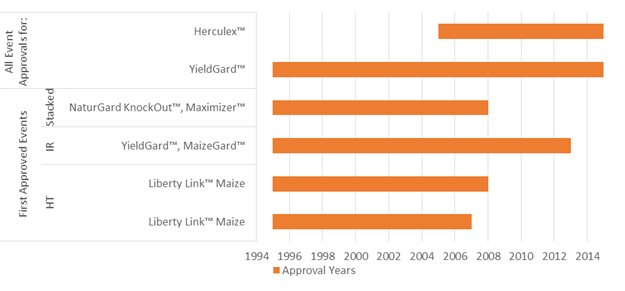
  1. The time between all approvals of the same event is long and well dispersed. In 1995 the US approved the first GM corn variety, Liberty LinkTM, its last approval was granted in 2007. The first GM corn variety had a 12 year approval lag between the first and last countries to approve it. This demonstrates how knowledge about the regulation of GM crops is not efficiently being shared between countries.

    Diffusion of regulatory knowledge for GM corn varieties
    Source: ISAAA, 2015

  1. Lags and approval delays demonstrates how knowledge diffusion does not happen at the same pace as GMs technology diffusion. This is apparent when the first approval for a stacked GM corn variety occurs in 1995 which was still receiving approvals in 2012. This is the fault of individual country regulatory protocols rather than collaborative research networks that share knowledge.

GM crop technologies are highly efficient and sophisticated processes, yet their approval processes are inefficient and rudimentary. High standards for assessing GM crops are necessary, however the scrutiny that each event must endure to receive approval by each individual nation is displacing the benefits from GM technology. It is unsettling how little progress regulatory system harmonization and knowledge communication among nations has occurred in over 20 years. Typically science and governments maintain that GM crops are safe and are essential tools towards increased nutrition and sustainability, yet the barriers to utilize GMs’ as essential tools are becoming more pronounced over time.

This raises a concern that our future regulatory systems will fall so far behind our technology innovations that gaps in regulatory approvals will lead to lost opportunities.

Savannah Gleim

Savannah joined Dr. Smyth's research team in the fall of 2014 and since has been an active member managing, editing, and writing for SAIFood. Prior to joining the SAIFood team, she completed her M.Sc. in Agricultural Economics and B.Sc. Agribusiness from the University of Saskatchewan.

Recent Posts

DNA Series: Interference RNA

The DNA Series: Hello everyone, this is going to be a series of blog posts.… Read More

05/12/2026

Canadian Agriculture: Struggling to Grow or Struggling to be Recognized?

Part 1 What if the loudest concerns about Canadian agriculture are only half the story?Agriculture… Read More

05/07/2026

Cheap Beef Today, Food Security Tomorrow

Why Canada Needs a Productivity Solution Karen Churchill CSO Canada is having a familiar conversation… Read More

05/05/2026

European Union Politicization of Scientific Risk Assessments

Following the 1962 publication of Rachel Carson’s Silent Spring, many people in society became more… Read More

04/30/2026

‘Slow Magic’ – The Economic Benefits of Canadian Swine Research

‘Slow Magic’ is the term coined for the economic returns on investment (ROI) in the… Read More

04/28/2026