
Swine Innovation Porc: Canadian Pork Success Stories

Swine Innovation Porc: Canadian Pork Success Stories

When we think about research, it can be easy to skip ahead to the conclusions and focus solely on those papers with immediate, real-world implications. However, the true impacts of innovation and research often take time to reveal themselves and what seems important to one person may be inconsequential to another. It’s important to resist the temptation to rush to judgements based on the popularity or size of an innovation, as this can cause us to miss industry revolutions happening outside the spotlight.
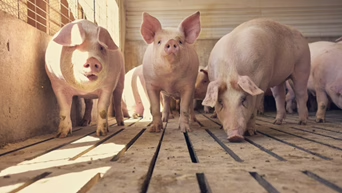
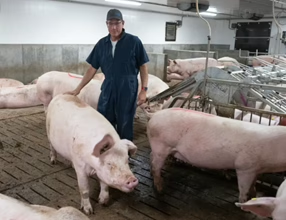
Swine herd
(Source)

Working quietly in the background of Canadian agriculture is Swine Innovation Porc (SIP), a national organization transitioning knowledge into useful additions to Canada’s swine sector. With base funding from Agriculture and Agri-Food Canada (AAFC) through national agricultural framework agreements, SIP works with funding partners and researchers to advance solutions that solve swine industry problems. From animal health and welfare to environmental and technological additions, SIP has worked with 224 experts and scientists across 74 public and private institutions since 2010 to investigate improvements to Canada’s pork survivability, competitiveness and market opportunity.

Over five-year funding cycles, the organization works with provincial pork boards to determine the focus of research calls within the areas of health, nutrition, quality, welfare, environment (and buildings) and technology. Beyond facilitating research funding, SIP provides researchers a platform to communicate impacts of their work to the larger swine industry. The primary goal of SIP is to move science into practice, as illustrated by the following selected case studies of SIP-funded research.

Long-term Biosecurity Benefits

If an animal disease is untreatable and highly contagious, governments will typically implement mandatory reporting. One such disease is porcine epidemic diarrhea (PED), a rapidly mutating, highly fatal disease that is transmitted through close contact. As a result, truck confinement when pigs are moved is a common vector for PED transmission. Cleaning between pig herds is essential to limit spread, but even workers stepping into a trailer to clean it can create new contamination.

In 2014, a group of researchers at the University of Saskatchewan started working on ways to break the infection chain in trailers. First, researchers at the Vaccine and Infectious Disease Organization (VIDO) determined that 75°C decontamination for 20 minutes was sufficient to inactivate even the most stubborn trailer pathogens. A collaborating team at the Prairie Agricultural Machinery Institute simultaneously developed a vacuum wash system to clear more bedding from trucks with less water. Phase 2 of the project, beginning in 2018, employed private, commercial truck wash companies to determine limitations of industry-available tools and cleaning processes. Based on these investigations, Transport Genie has introduced temperature sensors to their product line that offer better sensing of all corners of the trailer than previous offerings, while Truck Wash Technologies is working on improving their interior wash system quality. Meanwhile, in-trailer cleanliness and sensor criteria are being developed for greater consistency. The combined efforts from this collaboration have produced valuable innovations that improve our understanding and mitigation of livestock respiratory disease.

A Healthy Gut Feeling

Piglets are born with virtually sterile intestines, which means rapid early developmental nutrition is vital for their survivability. The more diverse and healthier a gut microbiome (influenced by milk and diet quality, disease exposure, herd interaction, etc.), the better the immune response and gut function. The challenge is that there is no defined optimal gut population, limiting the ability to improve piglet health.
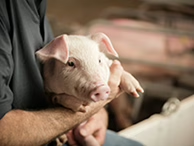
Piglet
(Source)

Using a wide researcher pool across Canadian universities, the Pig Gut Microbiome Project determined that approximately 30 per cent of a piglet’s intestinal gut microbiome population is shared by its mother, reaffirming the role of early colostrum intake – the protein- and antibody-rich “first milk” immediately following birth. The team also identified successive stages of microbial development in piglets, confirming the role of age in developing microbial populations. By providing insight into natural pig microbes, this research can be used in the Canadian swine sector’s pursuit of antibiotic-free pork.
Milk Quantity: The Lost Consideration

The swine industry has prioritized body conditioning and reduced aggression in genetic development and feeding strategies, inadvertently overlooking the impacts of some management choices on sow and gilt milk yield. For animals with litter sizes around 12 piglets per pregnancy, it is vital that there is adequate milk to jumpstart piglet immunity and gut development. Previous research focused on reducing excessive sow weight gain during pregnancy has missed the timing impacts on hormonal and nutritional management. This milk maximization project has explored when in the gestation (pregnancy) cycle feeding strategies help or hurt milk quantity.

The project focused on which interventions could improve mammary development, as that is a precursor to milk quantity. Feeding high-fibre diets pre-puberty, for example, can reduce excessive weight gain without compromising milk production. Feeding dietary lysine late in gestation can also stimulate mammary growth going into the lactation period. In the case of both feeding interventions, where the animal is in her gestation cycle matters for full benefits. As an additional, low-cost option, the prescription medication domperidone can be added to diets as a hormone-free milk stimulant. Providing farmers with more management options can both increase piglet resiliency and reduce operational costs.

What do Meat Packers Want?

What pork attributes are important to meat packers? Given the strictness of processing standards, one would think that every pork chop is the same. However, an investigation of private processors such as Olymel, HyLife, Conestoga Meats and Sunterra Meat Processors confirmed that what makes it to market and how it is assessed for quality varies by company. As assessors evaluate the meat, processors are both considering their end market and what can feasibly be implemented for consistent, objective assessment.

Through processing assessment, the research team determined that automation was more likely to be used for fat thickness or marbling, whereas traits such as grading flesh colour, regardless of the economic risk to poor grading, was completed by humans. In response, the project team focused on establishing an industry baseline, instead of promoting a single process, to determine the cost and credibility of grading automation for different processors. Being able to assess new tools and their implementation in commercial settings will improve Canada’s global reputation, signalling a new Canadian-driven marker of pork quality.

Policy Translation

Sow group housing
(Source)

Policy is constantly changing as new scientific information become available. One industry concern has been animal wellbeing. The natural sociability of pigs means individual and herd stress is reduced and their comfort improves when they are allowed to stay within a herd. There are management considerations that go along with this, such as individual feeding to reduce food-related aggression and ensure whole herd nutrition or alternative floor types to reduce injury.

The National Sow Housing Conversion Project, first introduced in Canada’s Pig Code of Practice in 2014, was scheduled to require farmers to transition their sow barns to group housing by the end of 2024. Following discussions with 12 farmers, the team behind this project identified a realistic cost of $250-$500 per sow for policy compliance, with the impact varying depending on farm size and related investments. As a result of this insight, the deadline for compliance has been extended to the end of 2029 to give farmers more time to make necessary barn changes. This project used its investigation of best management practices to advocate for farmers and provide benchmarks for regulatory requirements.
Canada’s pork sector generates over $5 billion in annual export value and operates in a highly competitive global market. Success depends on continuous improvement in productivity, quality and market access. Industry improvement does not have to be loud and disruptive, as quiet innovations such as the SIP-supported ones outlined above gradually but clearly improve Canadian productivity and growth. A recent study of SIP’s investments over 2010-23 showed a 30 per cent return on their portfolio of investment in these and other projects. SIP, with help from AAFC and more than 70 partner institutions, is working to enhance Canada’s resiliency, competitiveness and healthy food production.

The blog delved into only a handful of swine research topics. There are so many other great industry insights to explore!

To discover more from SIP’s network, take a look at their research highlights

Leave a Reply

Your email address will not be published. Required fields are marked *

SAIFood uses Accessibility Checker to monitor our website's accessibility.