


Pressed by Espresso
Pressed by Espresso

Pressed by Espresso

The Heated Price of Coffee

My morning starts with multiple cups of coffee. No, no individual needs that much caffeine at once, but I like the comfort a full mug brings and, much like the majority of Canadians, the rising costs have not pushed me towards tea. Between 2024 and 2025, Canadians saw a $0.31 increase per cup of coffee, moving our consumption from coffeeshops to home brewing rather than changing our consumption altogether. It goes against everything that economics tells us should be true, and yet, the coffee industry continues to innovate our experiences to make those extra cents feel worth it. 
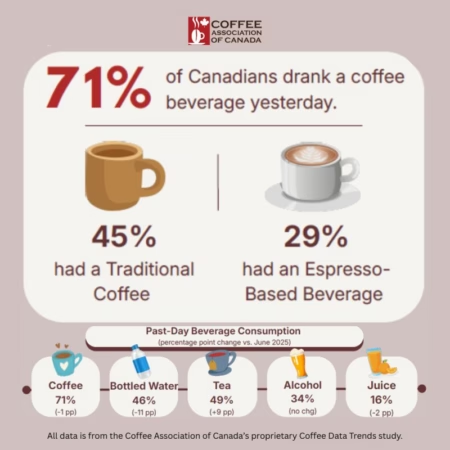
2025 Canadian coffee consumption: 71% of Canadians drank a coffee beverage yesterday
2025 Canadian coffee consumption trends (Source)

Perhaps we are used to it. The price of coffee has been steadily increasing since 2019, reaching a record high in February 2025, with the 2026 price per bag of beans now sitting comfortably at 223% of what the price was a few years ago. Our demand for coffee didn’t change; Colombia still saw an annual increase in the quantity of coffee exported. The necessity we feel about getting our fix in the mornings means coffee is incredibly price inelastic (i.e. price changes don’t affect our willingness to buy very much). Despite how protected we feel from coffee supply issues, it is important that we understand why the price of coffee continues to increase and how the sector is adapting in the shadow of food inflation. 
Why is coffee so expensive?

The nature of the coffee market is such that few companies can diversify how they participate. That’s why we’ll buy Nestlé for home, grab McCafe on our way into work, but we expect luxury from what we’re sitting down to enjoy in local coffee shops: they fulfill different needs. But, in Canada, we can’t grow coffee beans, so the prices we pay are direct reflections of production struggles in (sub)tropical regions like Brazil, Kenya, and Liberia. Production complications, like the extreme climate sensitivity of coffee beans that leads to disease potential and reduced yields, the risks to soil quality that threaten the long-term productivity of coffee fields, and a variety of global supply chain stalls are directly behind increased global attention to resiliency and improved production capacity. 

It is common for policy to move only after some shock necessitates action. Despite changes to the cost per cup, coffee prices are increasing slower than other food prices meaning we don’t notice the difference until analyses tell us to pay attention. The majority of coffee imported into Canada is unprocessed or unroasted, coming directly from the country it is grown but when countries our supply chains rely on are targeted, as was the case in 2025 when the United States temporarily added tariffs on the roasted coffee they export, Canadians notice the price jump. The diversity in the coffee sector further cushions Canadians from consumption-reducing price increases because it means we never face real scarcity; we just switch our source. For example, maybe our trips to Tim Hortons become less frequent but we don’t change the quantity of coffee consumed, or maybe the price is high enough that we step back from the Keurig for a while to buy ground coffee in bulk.  

We, as consumers, have a variety of coffee sources because the coffee industry invests in its own innovation. In Canada, our coffee segments are focused on convenience, which is why we are seeing an increase the availability of cold coffees and domestic extracts. Further, green bean trading occurs near zero and input costs are rising making it very difficult for especially small farmers or companies to make a profit and subsequently fund innovation. For this reason, large companies are more likely to absorb the competition (i.e. consolidate the marketplace) than experiment themselves. Approximately 60 per cent of the final quality we experience in our coffee cups is the result of processing (i.e. grinding, flavouring, roasting), implying that experimentation is entirely possible in countries that are not growing the beans. However, the ability to successfully scale those innovations is dependent on local capacity, as was the case with Gregg’s ceasing operations in New Zealand, specifically citing an inhospitable manufacturing environment for its factory closure in August 2026.

How can the sector adapt?

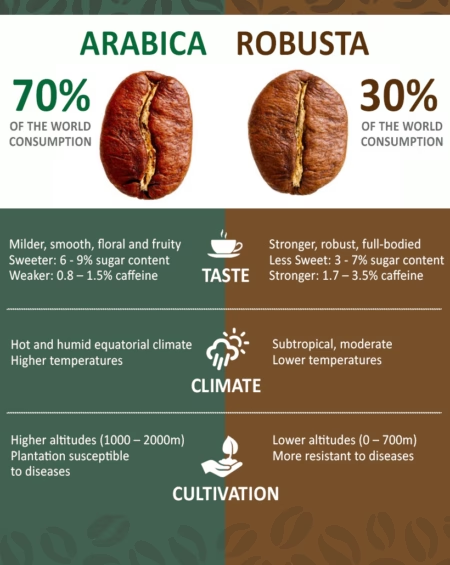
Comparison of arabica and robusta coffee beans, with pictures of beans and listed inforgraphics of differences relating to taste, climate, and cultivation
Comparison of arabica and robusta coffee beans (Source)

It is important to understand there are two main types of coffee beans: robusta, typically fulfilling the need for high caffeine, and arabica, which tends to be behind sweeter coffee profiles. Companies tend to market the beans separately as the “premium” qualities of each are their own major selling points however, brands such as Lavazza have made names for themselves selling blends that balance the taste and quality differences between the two bean types. Growing climatic stress has labelled robusta – the more heat-tolerant of the beans – a fallback to arabica, which is consumed more frequently; in instances where arabica supply is strained and likely will continue to struggle, robusta can supplement low inventories. While other types of beans do exist, like the indigenous liberica variety, they represent a much smaller proportion of global coffee consumption and production.

Climatic stress has forced governments to look for ways to increase the quantity of coffee produced to meet global demand. Liberia aims to have five million new coffee trees planted by 2050; Kenya hopes to triple the volume of coffee beans it produces by 2028; Papua New Guinea, too, plans to triple its kilograms of coffee per hectare through a variety of producer legislations. Improving how much farmers can produce extends beyond providing the trees, which has proven ineffective in historic uses; as Papua New Guinea’s 2025 Coffee Industry Bill reveals, true resiliency to trade shocks, market movements, and production challenges comes from focusing on legislation that makes the process easy for farmers. Taking a producer focus involves increased coffee varieties, improving plant biosecurity, licensing clarity, innovating towards resiliency, and equipment and support access especially for smallholder farms.

Coffee will always be a highly globalized commodity. As coffee growers in Australia acknowledge, it would take perfect growing conditions to reach their maximum coffee potential but, even then, domestic production could only fill two per cent of Australia’s coffee demand. Canada’s reliance on foreign countries for coffee means that, despite being cushioned from shortage, global supply challenges matter in our day to day. Noticing opportunities to be creative and innovate coffee production can only serve to diversify our experiences and keep our cups full, regardless of how you take it. 

Leave a Reply

Your email address will not be published. Required fields are marked *

SAIFood uses Accessibility Checker to monitor our website's accessibility.