Saskatchewan farmers rely on a vast toolkit of technologies to produce their crops every year. Farming practices are always changing, and innovation and adoption of new technologies are vital to improving agricultural efficiency, productivity, and sustainability. This is the third in a series of blogs that will dive into some of the important technologies used by Saskatchewan farmers and discuss the current issues surrounding them. Read the first blog on fertilizer use here and the second blog on pesticides here.
When the snow melts each spring, Canadian farmers focus on one important task: getting their seeds planted. From gardens to greenhouses to 160-acre fields, anyone who has planted seeds knows that it is more complicated than simply throwing seeds into the soil. Each crop, region, and soil type has different requirements that must be considered in the sowing of each field. Farmers have to juggle the complexities of seeding each spring, including seeding dates, depths, rates, and rotations. Not only are they juggling the challenges that come with seeding, but the coinciding fertilizer and pesticide applications have individual staging and timing requirements as well. Needless to say, grain farms are bustling with activity in the spring.
Prior to the widespread adoption of direct-seeding or no-till, which involves placing seeds directly into previous crop residues with minimal soil disturbance, seeding involved some form of tillage. Summerfallow every 2-4 years was also common to attempt to control weed populations through tillage and preserve soil moisture. However, major soil erosion problems from excessive tillage led to the widespread adoption of no-till operations in the late 20th century. Now, 86% of Canadian cropped acres and 95% of Saskatchewan cropped acres are farmed using no-till or minimum-till practices.
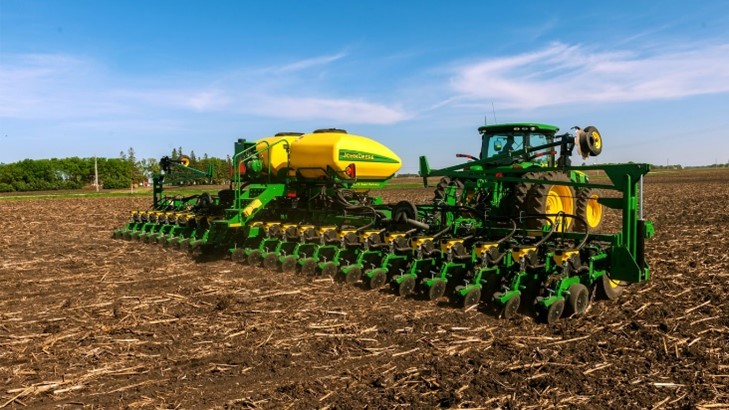
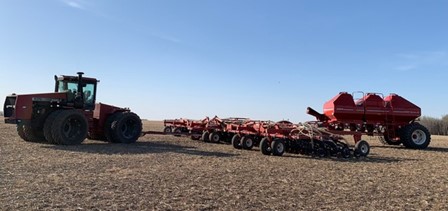
No-till seeding involves the use of direct planting equipment, traditionally an air seeder or an air drill pulled behind a tractor. The Saskatchewan company, Bourgault, operated out of St. Brieux, released the first air seeder cart to be pulled behind a cultivator and is still a world leader in air seeder technology today. Both air drills and air seeders have a fan that blows air into the main tubes which bring both seed and fertilizer to the opener where they are placed into the trench it creates.
Although the terms air drill and air seeder are often used interchangeably, the main difference between a traditional air seeder and an air drill is that drills do not have wheels inside the main frame carrying the openers; support for the frame comes mostly from the packer wheels at the back of the drill. One key advantage of the drill over the traditional seeder is the improved packing that the downward pressure of the frame on the back packing wheels provides. Row planters are another seeding implement used by some farmers, especially for crops with larger seeds such as corn or soybean. Planters provide improved depth control and precise seed placement over air drills. More recently, the adoption of precision agriculture has resulted in more farmers using precision drills and planters. Through advanced features such as sectional control, farmers are better able to vary product and seed application rates. This control minimizes input overlap, improving both environmental and economic efficiency.
Seeding implements can use either a single or double shoot opener system. This refers to how the seed and fertilizer are placed within the soil. In a single shoot system, there is one single line that delivers seed and fertilizer to the opener to be placed into the soil. In a double shoot system, two separate lines deliver seed and fertilizer to the opener. The openers in a double shoot system usually contain two separate furrows, one for seed and one for fertilizer, which is often placed deeper than the seed. The placement of the fertilizer in this way is known as side banding.
Besides choosing which crop farmers want to plant on which field, there are many other considerations farmers must take into account when planning their seeding season. The seeding date is one important aspect of planting a crop. In Saskatchewan, we often have nighttime freezing temperatures well into the spring and some crops are more susceptible to freezing than others. For example, canola plants that have emerged but are still in the cotyledon stage (the stage before a plant produces its first true leaves) can be killed by a hard spring frost. Wheat, on the other hand, is a more frost-tolerant crop in the early stages.
Each crop and each variety have a different number of days to maturity, which is the number of days from seeding to the crop being ready for swathing. Growing season conditions can impact the days to maturity as well. Therefore, choosing a seeding date that allows for enough growing days to harvest on time and that allows the plant to make use of available spring moisture while still trying to minimize the risk of a hard frost post-emergence is critical.
Seeding depth is another consideration dependent on soil moisture conditions and crop type. Small seeds, in general, require shallower seeding depths than large seeds. The deeper a seed is planted, the more energy and nutrients it will take for the plant to reach the surface. When moisture is limited, farmers may choose to plant their seeds deeper than they normally would to reach sub-surface moisture levels. An alternative strategy is to plant the seeds at a shallow depth and hope for a timely spring rain. Both methods carry risks but in the end, farmers must make the decisions they believe will give their crop the best chance at strong emergence and good yields.
While working hard to put their seeds in the ground, farmers are simultaneously planning pre-seed or pre-emergence chemical and fertilizer applications. As farms get larger, the complexity of planning seeding and input applications across fields increases. Furthermore, fertilizer rates and blends vary across crops and fields, as do chemical types and rates. Timing of chemical applications relative to the seeding date is critical as well, to avoid crop damage while also controlling the weed population as far into the growing season as possible. However, the reality is that limitations on equipment and labour mean that not all crops can be seeded on their ideal date and not all applications can be made in perfect timing. When it comes to planning spring field activities, farmers often have to settle for as close to perfect timing as possible.
Seeding sets up the crop for the rest of the growing season. Emergence, use of spring moisture, and harvest date are all influenced by the decisions made at seeding time, and these decisions can have major impacts on a farm’s total production. Although seeds being successfully planted in the soil signifies the end of the seeding season, it is only the beginning of the cropping season ahead. As soon as seeding wraps up, farmers jump into the thick of spraying season with their first round of in-crop herbicides. However, none of these growing season operations can reverse decisions and applications made during seeding, making seeding time one of the most critical seasons for Canadian grain farmers.
Chelsea began working with Dr. Smyth's team in 2019 as a Research Assistant. She completed her M.Sc. in Agricultural Economics in spring of 2021, studying the environmental benefits of GM technology. Before joining Dr. Smyth's team, Chelsea obtained her B.Sc. in Agribusiness from the University of Saskatchewan. She also owns and operates a grain farm with her husband near Handel, SK.
Since 2019, the public health and food innovation spaces have focused on increasing protein consumption.… Read More
Over the past few months, there has been an extreme amount of social media propaganda… Read More
With the amount of information in the world, it can be easy to get lost… Read More
The DNA Series: This is the last blog in the DNA Series (boo!), and we're… Read More
The Heated Price of Coffee My morning starts with multiple cups of coffee. No, no… Read More
In January 2026, the Canadian government was able to reach an agreement with the Chinese… Read More