


Over the past few months, there has been an extreme amount of social media propaganda about seedless fruits. These food extremists are desperately trying to mislead consumers into thinking that seedless varieties are somehow ‘unnatural’. Yet, nothing could be further from the truth. These are simply organic-funded scams trying to get consumers to buy overpriced, visually unappealing fruits.
The first mention of seedless fruits dates back to the writings of Pliny the Elder in 75 AD, when he writes about a seedless variety of grapes known as Zante currents or more commonly Corinthian raisins. With seedless varieties of fruits having existed for a mere 1,950 years, the seedless fruit alarmists clearly failed high school and university biology and history classes!
Seedless Fruits Common in Stores
Seedless fruits are common across grocery store shelves. Seedless varieties are not genetically modified, but have been developed through cross breeding efforts dating back decades or even centuries. Seedless grapes have existed since the early 1870s, making this technology 150 years old. Seedless watermelon were developed in the early 1950s and have been eaten for over 75 years. Seedless oranges were first discovered in Brazil in the 1870s, another technology that is 150 years old. Seedless lemons were bred in Australia in the 1930s, making this technology nearly 100 years old.
Many seeded fruit varieties make consumption very difficult. One just has to look at the seeded bananas below to get a sense of how unappealing eating this would be. Not to mention: how many parents would deliberately purchase seeded raisins?
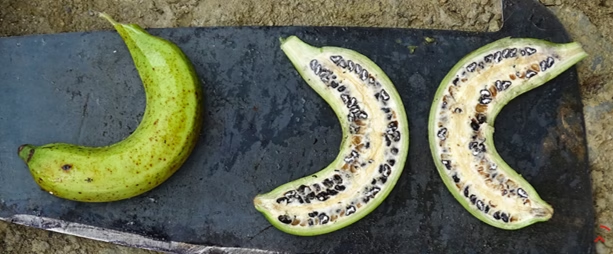
Naturally seeded bananas (Source)
Demand for Seedless Fruits
The key thing the organic alarmists deliberately ignore is consumer demand. When seedless fruit varieties were developed, consumer demand was strong for these products, as it meant less time picking seeds out of fruits prior to feeding them to their children to ensure they were safe to eat, as well as for use in recipes. High demand led to additional research being conducted on fruit varieties to develop seedless varieties. There has been an increase in research on the development of seedless, or pitless, stone fruits such as cherries, peaches, apricots, etc. Had consumer demand not been strong for seedless varieties, the production of them would have dwindled and the varieties available would be a fraction of what they are today.
Beyond strong consumer demand for seedless fruits, there is also strong industry demand. The removal of seeds and pits represent a cost for food processors, such as those that produce fruit juices, jams, and jellies. While the majority of seeds end up as an unusable by-product and have to be hauled to garbage dumps, some niche markets have developed over time for seeds, such as the crushing of raspberry seeds to create oil. A good example of processing requirements is seen with cherries to make pie filling or as garnishes for cakes, where the pits have to removed from all of the cherries prior to being processed, increasing the price of these products in grocery stores.
Trends in Research on Seedless Fruits
Given the strong consumer demand for seedless fruits, significant research exists on the development of more varieties to meet these demands. Pairwise is a company in North Carolina that is using gene editing technologies to develop seedless blackberries and cherries. Pairwise has used gene editing to remove the thorns from blackberry plants, as well as making the fruit seedless. Not only are the blackberries easier to pick due to the removal of thorns, the plants have increased water use efficiency, requiring less water to produce a pound of fruit than conventional blackberry production.
Research is developing new fruit varieties that meet with consumer, not alarmist, demands. In spite of what alarmists are desperately trying to communicate, consumers are not demanding seeded grapes, watermelon, or bananas. The success of all technologies that get commercialized are ultimately decided by consumers and consumers have strongly expressed the desire to purchase seedless fruit varieties. They have been doing so for decades. Consumers will be able to enjoy seedless fruit varieties in more fruits than previously was the case.
