
‘Slow Magic’ – The Economic Benefits of Canadian Swine Research

‘Slow Magic’ – The Economic Benefits of Canadian Swine Research

‘Slow Magic’ is the term coined for the economic returns on investment (ROI) in the agricultural sector which can take decades or longer to be maximized. This extended ROI timeline is due to the extensive time (~10-15 years) required to develop new varieties of both crops and livestock. In other sectors ROI is realized more quickly because adoption times and product cycles are shorter. In agriculture peak adoption timelines are considerably longer as farmers do not replace equipment or livestock as rapidly consumers change cellphones or cars.

Investing in Swine Research

In 2008, Agriculture and Agri-Food Canada (AAFC) announced a new five-year strategic agricultural research funding program, known as Growing Forward. In 2010, Swine Innovation Porc (SIP) was established to facilitate and coordinate swine research across Canada. AAFC has since renewed three more five-year agricultural research funding frameworks (2013-17, 2018-22 and 2023-28).

SIP commissioned an economic impact study based on swine research investments undertaken between 2010 and 2023. During this period, SIP invested nearly $50 million, with another $20 million planned for 2024-2028. During 2010-2023, 36% of the funds were invested in animal health, 24% in nutrition, 21% in environmental projects, 11% in pork quality and 8% in animal welfare.
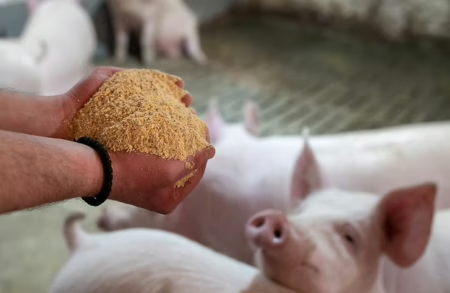
Feeding handfuls of grain to feeder pigs
(Source)

SIP research investments generated about $20 million in yield enhancing improvements for farmers and $47 million in increased market for pork, yielding a 30% ROI on the investment portfolio. In macroeconomic terms, the investments and related innovations between 2010-2023 contributed $225 million to Canadian gross domestic product (GDP), $85 million attributed to the research effort, $42 million to efficiency improvements at the farm level and $101 million from increased demand for pork.

Farmers are the main benefactors of SIP’s strategic investments. In aggregate farmers and others in the supply chain invested $12.9 million in 2010-23 and realized about $67 million in direct benefits in terms of higher yield and higher sales, delivering a 5-1 ratio of benefits to costs. The average pork producer invested about $1,700 over the period under study and realized about $8,800 in return.

Sustainability Advances

A principal tenant of sustainable agriculture is to produce more with fewer inputs. The drive to achieve this result in research investments targeted at increasing livestock’s ability to gain more weight per pound of feed, to increase livestock’s immunity to disease, to improve the nutrition of the resulting meat products and to reduce livestock impacts on the environment. Swine research investments have been made along the entire research spectrum, from improved genetics to improved bioeconomy opportunities for swine production waste.

Since 2010, swine research in Canada has improved animal genetics, allowing for greater feed-use efficiencies, so that pigs gain more weight for every pound of feed consumed. This reduces the overall amount of feed and water required to get a pig to market weight, as well as reduces the amount of greenhouse gas (GHG) emissions required to produce the feed for each pig.

Improving disease resistance in swine also provides significant sustainability benefits. Swine are like humans when they get sick – they eat less and often require medicine to get better. Research has targeted to increase resistance to respiratory disease which works to improve animal welfare, reducing the number of pigs that get sick and allowing them to reach their market weights more quickly.

Finally, research has been conducted on how to reduce the environmental impacts of swine production. This involves, for example, ways to better utilize the manure such as an input for bio-energy digestors.

Looking Forward

Swine production is a key part of Canada’s agriculture, accounting for over $5 billion in export value annually. Given the growing value of pork exports and the estimated 30% return on investment, there is a case to be made for further research investments. In addition to improving yield and generally improving quality, there are real needs to respond to rising global disease threats, notably the endemic threat from African Swine Flu.

Canadian consumers benefit from increased pork production as investments to improve productivity help to provide consumers with relatively lower priced protein options. The $50 million invested by SIP from 2010 to 2023 has provided economic benefits along the entire pork supply chain, from academic researchers to farmers to consumers. Continued support for the Canadian swine sector should be a cornerstone of future funding frameworks.

Leave a Reply

Your email address will not be published. Required fields are marked *

SAIFood uses Accessibility Checker to monitor our website's accessibility.