


The Role of Economics in Canadian Track Closures
It’s horse racing season. Rather, for Canadians, it should be.
Despite being one of mankind’s oldest sports and contributing $8.7 billion annually to the economy, Canada is disappearing from the thoroughbred racing industry. The horse racing bioeconomy, regardless of breed or sport specifics, is governed by the balance of three domains: animal health/welfare, social license, and economic viability. The three are not weighted the same in decision making, but the absence or alteration to one domain requires the other two also adjust. For example, the gap in attendance caused by the COVID-19 pandemic was a turning point for confidence in the sport; without the crowds, the economic limitations of horse racing were spotlighted. This blog is a look at how the bioeconomic balance, or the lack thereof, has contributed to the decline in Canadian horse racing.
If you support the animal rights movement, then you are an individual who believes sport should not be a category, as animals should not serve or be owned by humans. I am a biased lover of thoroughbred racing and so, this discussion takes a different approach, instead advocating for enhanced welfare as the bare minimum standard of care. An enhanced welfare perspective uses nutrition, environment, health, behaviour, and mental state to help the animal thrive in an admittedly high risk, highly regulated sport like racing. While management and racing decisions can be controlled for the betterment of the sport, genetic strength – a valid concern in 2026 as 19 of the 20 horses that competed in the Kentucky Derby were direct descendants of legendary racer, Secretariat – is outside the scope of this discussion.
Sport Realities
In part, the success and fairness of racing is the responsibility of participants, who have all the incentives to ensure a high quality of horse care, and unfortunately similar incentives to win. The majority of fines and suspensions in Canada’s 2025 racing season were doled out to jockeys for interference with other riders or crop violations (which are required to remain below the horse’s shoulder, away from the face), and trainers who entered horses into races for which they were ineligible. Racing regulations are in place to ensure safety and differences in standards cloud racing transparency. Sport officials are few and far between, often times requiring a small pool of talented individuals to travel to numerous distant tracks for work.
Annually, upwards of 20% of racing horses are removed from racing either through retirement or injury. The vast majority of injuries are not career-ending, although racing prioritizes youth and physical prowess. Horses are considered at their racing peak around four years old, moving numerous animals into other professions (i.e. jumping, dressage, pleasure) upon racing retirement. Yet, the number of two-year-olds entering the racing industry is also on the decline, suggesting that thoroughbred racing is not as attractive a venture as it once was.
Cost of Participation
Much like other agricultural sectors, the cost to participate is realised before the animal makes money. The rising cost of farmland is not unique to crop farmers, nor are increasing feed prices to meat production, which serve as some of the largest deterrents to industry entry. Further, horse centres thrive when they act as a physical connector between urban and rural regions, offering unique economic opportunities with greenspace, which coincidentally have some of the highest land costs.
The costs associated with the two years prior to racing age, including caring for the mare and the cost of insemination, are almost entirely incurred by the breeder; that individual makes money based on the sale of their horse.
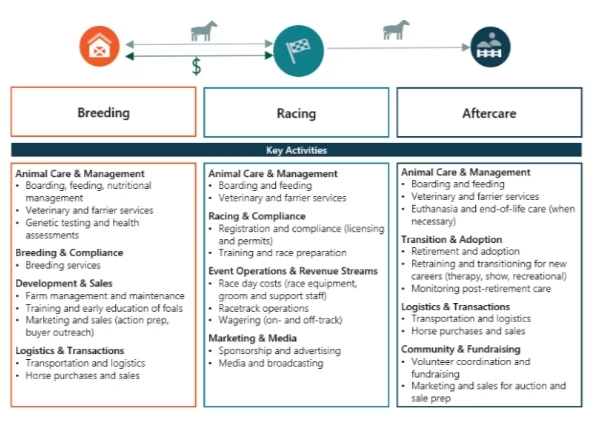
Connections within provincial horse racing industries (Government of BC, 2024)
The value of an untrained foal is the theoretical success based on pedigree: how does the yearling look at sale and how well has its bloodline raced in the past? As a result, thoroughbreds sell for tens of thousands of dollars on the low end, although that price often incompletely compensates the breeder for years of feed, board, and care costs. The direct value of racing is in the sale of horses and sector employment, which does not only consider individuals spending time at the track.
Direct value outpaces indirect sources of income like betting or tax generation however both direct and indirect value creation are required to encourage the other. In theory, wagering draws in the crowds and crowd consistency improves sport interest and investment. The perception of ‘luxury’ with high performance horses has spurred brands like Woodford Reserve and Rolex to promote elite experiences for the average viewer. The breaks between racing seasons should be periods of strategy including with brand partners however, between short-term or inconsistent support structures and jurisdictions that do not consider horses as agriculture, the racing pause has merely reminded the community of the costs to participate.
Where is Canada?
Racing seasons are business deals made between the track and the local racing commission. The commission looks at regional athlete availability, animal welfare restrictions, and parimutuel betting expectations to negotiate the number of race days allowed per year and rental agreements for barn space. Racetracks are businesses and so financial strain, like reduced income in response to pandemic-related gathering restrictions, force tracks to make difficult decisions.
In 2025, following years of poor attendance and a lack of marketing, both Marquis Downs (Saskatoon, Saskatchewan) and Fraser Downs (Surrey, British Columbia) were officially slated for demolition. In two days, harness racing track, Rideau Carleton Raceway (Ottawa, Ontario), went from negotiating the 2026 racing season to shuttering its doors in response to financial difficulty. Workers in Vancouver, British Columbia, were similarly blindsided by the closure of the 130-year-old Hastings Racecourse; much like with Marquis Downs, the decision to end racing was partially informed by the attractiveness of soccer and its (potential and yet unrealized) replacement in those spaces. As of 2026, there are only four active thoroughbred tracks and 20 remaining standardbred tracks, none of which remain in Saskatchewan.
From a short term business perspective, the closures unfortunately make sense. The problem is that it ripples through the racing community, impacting decisions that were made years prior. Track closures in 2025 affected individuals in 2023, who raised their yearlings only to be told there was no market for them. While activist groups may praise the end to racing, it does very little to address the legitimate welfare concerns with the sport and may actually limit quality of care depending on whether the cut off services can be substituted elsewhere (i.e. across interprovincial borders).
Equine services are not independent from agricultural challenges faced in other sectors (i.e. education constraints, labour loss, land availability, feed prices, etc.), which makes short term or year-to-year negotiations confusingly naïve. The breeding cycles of performance horses necessitate long-term planning with direct and indirect stakeholders. Especially as Canada struggles to realise where it can invest in its agricultural industries, the cascading annual loss of revenue generation in the hundreds of millions limits who and what we can attract. If we’re not going to adequately leverage our agricultural opportunities, we cannot be surprised when we lose them altogether.