
A Loose Intro to Precision Fermentation

A Loose Intro to Precision Fermentation

In a marketplace constantly asking for diversity and sustainability in addition to food quality, globally, we are running out of space to do so. For this reason, the agriculture industry is turning to precision tools in order to minimize waste and optimize production. In many ways, precision agriculture is similar to selective plant breeding except modern technologies allow more certainty in what is produced. One lesser-known (but no less profitable) segment of both the pharmaceutical and food processing spaces is precision fermentation, a less input-intensive production process for certain food products compared to its conventional counterpart. The global interest in precision fermentation has led to initiatives such as the Biotech Open Platform in France, to further develop advanced technologies and streamlined processes. Within recent years, Canada has seen an increase in startup companies entering the space attempting to capitalize on a nutrition gap consumers have noticed, to varying degrees of success. While this blog won’t delve too far into specific ventures, it will discuss the existing dynamics within precision fermentation because, while being looked to as an emerging solution to more than one facet of food insecurity, Canada still lags behind other parts of the world in capacity. 

How Novel is Precision Fermentation?

Precision fermentation falls under the umbrella of cellular agriculture, which uses complex chemistry to build food tissues from cell samples. As the name suggests, precision fermentation (PF) is a form of highly controlled, specific fermentation (sugar conversion). Fermentation is an ancient food storage and flavour enhancing process with strong significance across cultures, responsible for common products like alcohols, cheeses, soy sauces, sourdoughs, and yogurts. With PF, however, the conversion is stimulated in microorganisms like bacteria and fungi to create high concentrations of individual components (i.e. proteins, fats, vitamins, etc.). The specifics for environmental controls like host bacteria, pH, and growth medium vary depending on what ingredient is being targeted, but overall, PF follows 3 phases of development: a developmental phase, an optimization/scaled production phase, and cell harvesting or purification. It is these specific and measurable conditions that, when understood, allows for scalable, bulk production of nutrients at a scale natural fermentation cannot accomplish. 
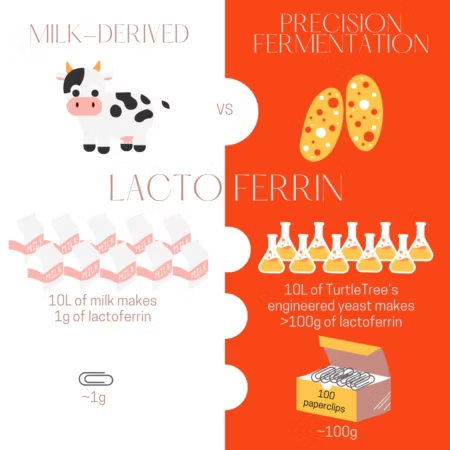
Differences in lactoferrin production, with milk-derived processes on a white background and precision fermented derivation on a red background. g of lactoferrin production per 10L is described in terms of number of 1g paper clips
Difference between milk-derived and precision fermented (from TurtleTree) lactoferrin production (Source)

Highly technical sounding terms can be intimidating but, Canada’s marketplace has had PF products on the shelves for decades. Insulin, for example, has been purchasable since the 1980s and citric acid – the substance behind all things sour – has been available through PF since 1990. Beyond individual components, products produced with PF are readily available in Canadian dairy, eggs, honey, and coffee sectors. Dairy, and dairy protein in particular, is the largest market occupier in the PF space today; PF promises to reduce global reliance on intensive livestock operations, offering a more sustainable, resource efficient, and cost-efficient alternative. Some startup companies are using fermented ingredients with plant-based ingredients to create a dairy substitute that performs identically to conventional cheese when their products are stretched; by isolating beta-lactoglobulin (a subcomponent of whey), other companies are able to improve the protein quality of drinkable yogurts without compromising the texture. 

What it Costs to Scale

Precision fermentation can be cost efficient compared to conventional agriculture because of the speed at which nutrients are produced and the reduced quantity of inputs required for production. A 200,000-litre tank of growth medium, while costly to develop and scale, does not require the same operational costs as a 1,000 head dairy operation, and would likely produce more of the desirable substance. These efficiencies are contingent on food safety and risk management, which can impact the quality of output and how costly the process. The cost of fermentation can be reduced depending on what is being used to feed the microorganism provided, as stated, food safety and contamination hazards are fully considered. For example, soy and canola meals, as by-products of commercial distilling operations, reduce the cost of PF over unused soy and canola meals, but at the risk of medium contamination. However, the novelty of PF has worked the industry into a snake eating its own tail scenario, where the costs of PF (the R&D, the equipment, the expertise required) prevent scalability and company survivability; the inability to scale limits market access, investment opportunity, and overall availability; and the subsequent lack of demand prevents the ability for PF companies to improve production efficiency and reduce the cost of production. There is no value to an opportunity if support structures are not in place to help the reach the potential. 

The novelty of PF has also created a challenge on the regulatory front. While Canada still requires foods produced using PF follow the same health and safety assessments as conventional approvals, there is no legislative definition. No country has a binding definition, which means that regulation has largely been up to the discretion of each nation. These regulations are then complicated by additional conflicting opinions towards special cases like PF processes that use genetically modified yeasts as the host strain. 

Regulatory overview of precision fermentation in select countries as of 2024 (Source)
Canada
China
European Union
Singapore
United Kingdom and Northern Ireland
United States of America
PF definition
No
No
Working definition exists
No
No
PF-specific regulations
No
No
No
No
No
No
Premarket food safety assessment
Required
Required
Required
Required
Required
Voluntary (but encouraged)
Food safety assessment guidelines
Yes
Yes
Yes
Yes
Yes
Yes
Presubmission consultation
Available
No
Available
Encouraged
Encouraged
Strongly encouraged
Labelling requirements
Yes
Not PF specific
Not PF specific
Not PF specific
Not PF specific
Not PF specific

Standardizing the regulatory framework is one of the dominating suggestions to improve the commercial opportunities for precision fermented products. As it stands, PF exists in a “regulatory gray zone,“ attempting to squeeze into a system that separates conventional, novel, and drug uses while really fitting into all three depending on the process. Brazzein, for example, is a water-soluble sweetener that can be used in smaller quantities as a sugar replacement for the same sweetness; where brazzein is used, despite being the same substance, changes which assessments and transparency benchmarks are made. 

There are real opportunities for PF to be used alongside conventional agriculture, especially as it serves as an end-use for by-product wastes. Realising those opportunities, however, is dependent on the marketplace, which seems to be more skeptical than welcoming to food innovation regardless of overarching commitments to sustainability. An efficient, profitable marketplace requires support structures and consistency in expectation – two major infrastructure challenges preventing Canadians from widespread availability. A national strategy for PF may meaningfully guide the industry around scaling barriers, but only if the innovation landscape remains open and hospitable to novelty. 

Leave a Reply

Your email address will not be published. Required fields are marked *

SAIFood uses Accessibility Checker to monitor our website's accessibility.